
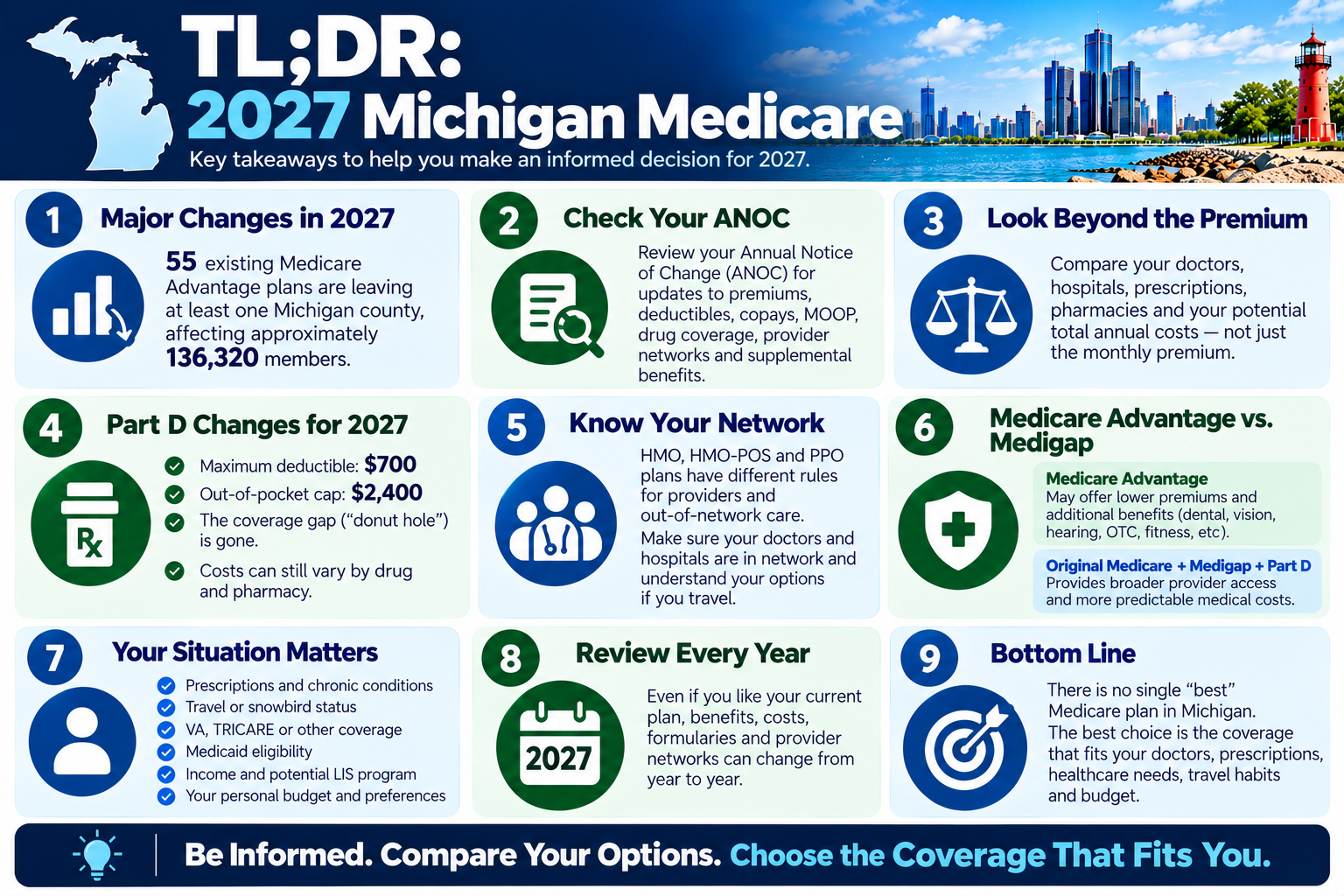
How to Compare Medicare Advantage, Part D, and Medicare Supplement Plans and Choose the Right Coverage for 2027
Choosing Medicare coverage can be confusing in any year, but 2027 is an especially important year for Michigan Medicare beneficiaries to review their options.
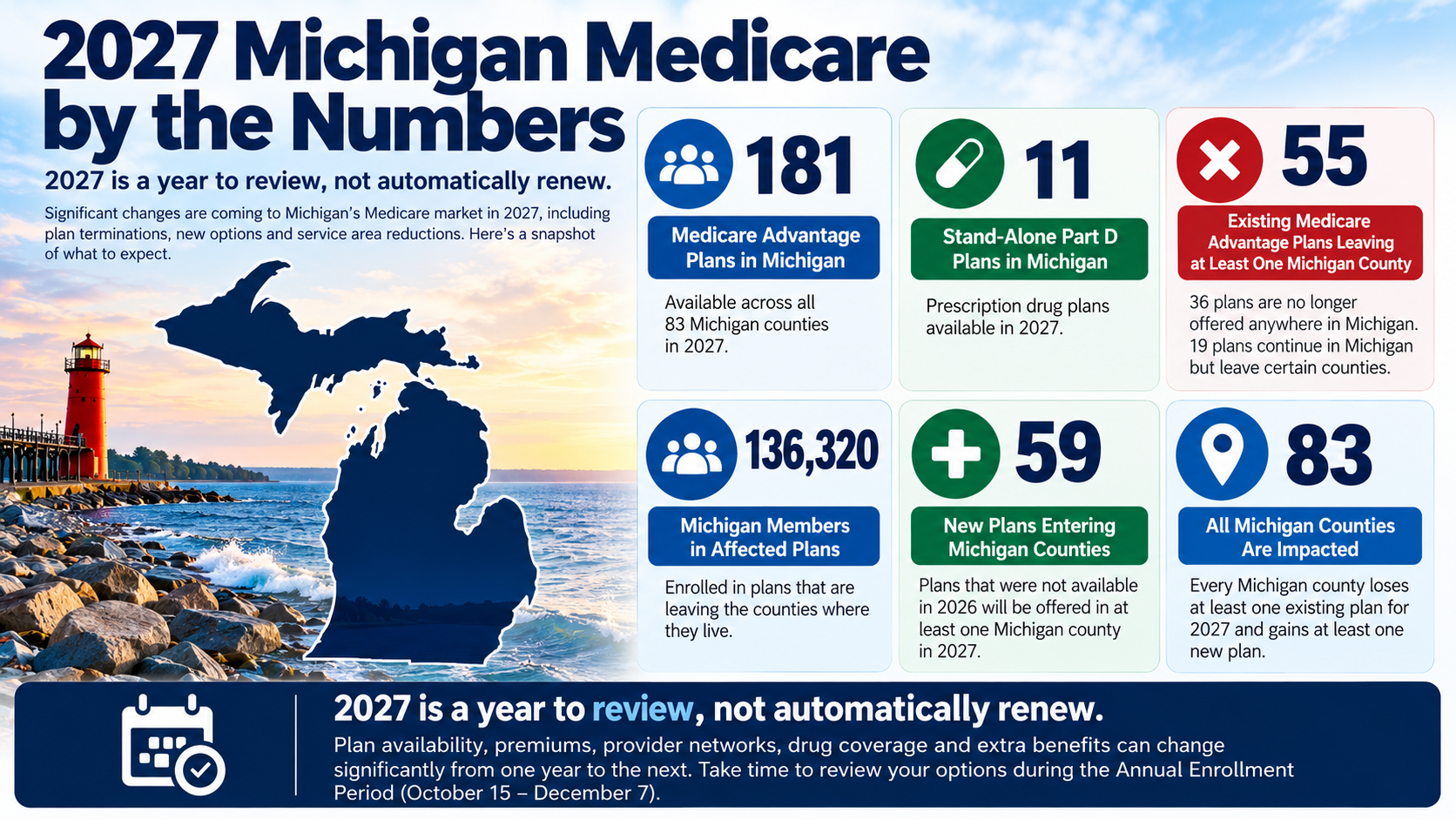
Michigan has more than 2.3 million Medicare beneficiaries. For 2027, 181 Medicare Advantage plans are available across Michigan, compared with 192 in 2026. The average Michigan Medicare Advantage premium is increasing from $14.88 per month in 2026 to $16.21 in 2027, although every Michigan Medicare beneficiary continues to have access to at least one $0-premium Medicare Advantage plan. Michigan also has 11 stand-alone Medicare Part D prescription drug plans available for 2027.
Those statewide numbers tell only part of the story.
Medicare Advantage is local.
A plan available in Grand Rapids may not be available in Traverse City, Detroit, Marquette, or another Michigan community. Provider networks, prescriptions, pharmacies, copays, and supplemental benefits can also vary substantially from one plan to another.
This guide is designed to help Michigan residents understand those differences and make a more informed Medicare decision for 2027.
Michigan's Medicare Advantage Market Is Changing
Significant movement is happening beneath Michigan's statewide plan count.
An analysis of CMS's September 2026 landscape and enrollment files found that 55 plans offered somewhere in Michigan during 2026 are leaving at least one Michigan county for 2027. Of those, 36 are no longer offered anywhere in Michigan, while 19 continue in Michigan but leave certain counties.
Every one of Michigan's 83 counties loses at least one existing plan.
Based on September 2026 enrollment, approximately 136,320 Michigan members were enrolled in plans leaving the counties where they live. At the same time, 59 plans are entering at least one Michigan county where they weren't offered in 2026.
That doesn't mean Medicare Advantage is disappearing from Michigan. CMS reports that Michigan beneficiaries continue to have Medicare Advantage options for 2027, including access to $0-premium options.
What it does mean is simple:
2027 isn't a good year to assume your 2026 coverage will remain your best option.
Michigan 2027 Plan Terminations and Service Area Reductions
The numbers deserve special attention:
55 existing Michigan plans leave at least one county for 2027.
36 of those plans disappear entirely from Michigan.
19 continue in Michigan but withdraw from certain counties.
All 83 Michigan counties lose at least one existing plan.
Approximately 136,320 existing members were enrolled in affected plans in the counties those plans are leaving.
At the same time, 59 plans enter at least one Michigan county where they weren't available in 2026.Advantage Index
Medicare Advantage Plans Ending in Michigan for 2027
The following Medicare Advantage plans offered in Michigan in 2026 are ending in the listed Michigan counties for 2027. Members enrolled in an affected plan should carefully review their 2027 Medicare coverage options.
| Insurance Company | Plan | Plan ID | Michigan Counties It Leaves | Members Affected |
|---|---|---|---|---|
| UnitedHealthcare | UHC Dual Complete MI-Y1 (HMO D-SNP) | H2247-005 | Barry, Berrien, Branch, Calhoun, Cass, Kalamazoo, Macomb, St. Joseph, Van Buren, Wayne | 17,610 |
| Priority Health Medicare | PriorityMedicare Key (HMO-POS) | H2320-022 | Alcona, Antrim, Benzie, Charlevoix, Clare, Crawford, Grand Traverse, Lake, Leelanau, Manistee, Mecosta | 12,765 |
| Priority Health Medicare | PriorityMedicare Vital (PPO) | H4875-022 | Allegan, Barry, Kent, Lenawee, Ottawa | 10,163 |
| Priority Health Medicare | PriorityMedicare Vital (PPO) | H4875-022 | Berrien, Calhoun, Cass, Ionia, Isabella, Kalamazoo, Mason, Midland, Missaukee, Montcalm, Muskegon, Newaygo + 6 more counties | 8,093 |
| Humana | Humana Full Access H7617-055 (PPO) | H7617-055 | Macomb, Oakland, Wayne | 7,640 |
| Humana | Humana Full Access H5216-287 (PPO) | H5216-287 | Macomb, Oakland, Wayne | 6,985 |
| Priority Health Medicare | PriorityMedicare Key (HMO-POS) | H2320-022 | Alpena, Cheboygan, Emmet, Gladwin, Iosco, Kalkaska, Montmorency, Oscoda, Presque Isle, Roscommon, Sanilac | 6,737 |
| Humana | Humana USAA Honor Giveback with Rx (PPO) | H5216-305 | Alcona, Alger, Allegan, Alpena, Antrim, Arenac, Baraga, Barry, Bay, Benzie, Berrien, Branch + 71 more counties | 5,554 |
| Priority Health Medicare | PriorityMedicare Vital (PPO) | H4875-022 | Arenac, Bay, Branch, Clinton, Genesee, Huron, Ingham, Livingston, Macomb, Oakland, Ogemaw, Saginaw + 3 more counties | 5,366 |
| Humana | Humana USAA Honor Giveback with Rx (PPO) | H7617-071 | Alcona, Alger, Allegan, Antrim, Arenac, Baraga, Barry, Bay, Benzie, Berrien, Branch, Cass + 61 more counties | 3,631 |
| Priority Health Medicare | PriorityMedicare Vintage (HMO-POS) | H2320-031 | Allegan, Arenac, Barry, Bay, Berrien, Branch, Calhoun, Cass, Clinton, Genesee, Huron, Ingham + 26 more counties | 3,390 |
| Wellcare | Wellcare Simple Open (PPO) | H2117-001 | Allegan, Arenac, Barry, Bay, Branch, Calhoun, Cass, Crawford, Eaton, Genesee, Gladwin, Gratiot + 36 more counties | 2,853 |
| Priority Health Medicare | PriorityMedicare Thrive Plus (PPO) | H4875-018 | Alcona, Antrim, Benzie, Charlevoix, Clare, Crawford, Grand Traverse, Lake, Leelanau, Manistee, Mecosta | 2,058 |
| Paramount Elite Medicare Plans | Paramount Elite Standard (HMO-POS) | H3653-015 | Branch, Hillsdale, Lenawee, Monroe, Washtenaw | 1,181 |
| Priority Health Medicare | PriorityMedicare Thrive Plus (PPO) | H4875-018 | Alpena, Cheboygan, Emmet, Gladwin, Iosco, Kalkaska, Montmorency, Oscoda, Presque Isle, Roscommon, Sanilac | 1,039 |
| Wellcare | Wellcare Dual Access Open (PPO D-SNP) | H2117-002 | Allegan, Arenac, Bay, Genesee, Gladwin, Gratiot, Hillsdale, Huron, Jackson, Kent, Lake, Lapeer + 16 more counties | 1,005 |
| Wellcare | Wellcare Patriot Giveback Open (PPO) | H2117-003 | Allegan, Arenac, Barry, Bay, Branch, Calhoun, Cass, Crawford, Eaton, Genesee, Gladwin, Gratiot + 36 more counties | 821 |
| Paramount Elite Medicare Plans | Paramount Elite Enhanced (HMO-POS) | H3653-004 | Branch, Hillsdale, Lenawee, Monroe, Washtenaw | 731 |
| Paramount Elite Medicare Plans | Paramount Elite Prime (HMO-POS) | H3653-022 | Branch, Hillsdale, Lenawee, Monroe, Washtenaw | 560 |
| Humana | Humana Gold Plus H8908-001 (HMO-POS) | H8908-001 | Genesee, Ingham, Lapeer, Livingston, Macomb, Oakland, St. Clair, Washtenaw, Wayne | 535 |
| Aetna Medicare | Aetna Medicare Prime Care (HMO-POS) | H3192-021 | Genesee, Macomb, Oakland, Wayne | 427 |
| Humana | Humana Gold Plus Chronic Kidney Disease (HMO C-SNP) | H8908-006 | Genesee, Ingham, Lapeer, Livingston, Macomb, Oakland, Sanilac, St. Clair, Tuscola, Washtenaw, Wayne | 356 |
| Paramount Elite Medicare Plans | Paramount Elite Preferred (PPO) | H5232-001 | Branch, Hillsdale, Lenawee, Monroe, Washtenaw | 346 |
| Blue Care Network | BCN Advantage Elements (HMO-POS) | H5883-001 | Macomb, Oakland, Washtenaw, Wayne | 314 |
| Blue Care Network | BCN Advantage Elements (HMO-POS) | H5883-001 | Antrim, Benzie, Clinton, Emmet, Genesee, Grand Traverse, Isabella, Lake, Lapeer, Leelanau, Lenawee, Livingston + 8 more counties | 253 |
| UnitedHealthcare | Erickson Advantage Signature (HMO-POS) | H5652-001 | Oakland | 219 |
| Blue Care Network | BCN Advantage Elements (HMO-POS) | H5883-001 | Allegan, Barry, Ionia, Kalamazoo, Kent, Mason, Muskegon, Newaygo, Oceana, Ottawa | 199 |
| Blue Care Network | BCN Advantage Elements (HMO-POS) | H5883-001 | Alcona, Alpena, Arenac, Bay, Charlevoix, Cheboygan, Clare, Crawford, Gladwin, Huron, Iosco, Kalkaska + 12 more counties | 180 |
| Blue Care Network | BCN Advantage Elements (HMO-POS) | H5883-001 | Berrien, Branch, Calhoun, Eaton, Gratiot, Hillsdale, Ingham, Jackson, Monroe, Montcalm, St. Joseph, Van Buren | 169 |
| Aetna Medicare | Aetna Medicare Enhanced (PPO) | H5521-607 | Barry, Branch, Calhoun, Clinton, Eaton, Genesee, Hillsdale, Ingham, Ionia, Jackson, Kalamazoo, Kent + 17 more counties | 49 |
| UnitedHealthcare | Erickson Advantage Liberty (HMO-POS) | H5652-008 | Oakland | 47 |
| UnitedHealthcare | Erickson Advantage Champion (HMO-POS C-SNP) | H5652-004 | Oakland | 20 |
| UnitedHealthcare | Erickson Advantage Freedom (HMO-POS) | H5652-006 | Oakland | 16 |
| UnitedHealthcare | Erickson Advantage Liberty no Rx (HMO-POS) | H5652-002 | Oakland | 11 |
| UnitedHealthcare | Erickson Advantage Guardian (HMO-POS I-SNP) | H5652-003 | Oakland | Fewer than 11 |
| Wellcare | Wellcare Dual Reserve (HMO-POS D-SNP) | H5475-039 | Allegan, Arenac, Bay, Genesee, Gladwin, Gratiot, Hillsdale, Huron, Jackson, Kent, Lake, Lapeer + 16 more counties | Fewer than 11 in each |
Source: CMS 2027 Medicare Advantage landscape data and September 2026 enrollment data, compiled by Advantage Index. CMS suppresses county enrollment counts of 10 or fewer.
2027 Michigan Medicare Carrier List
2027 Michigan MA carrier lineup includes:
Aetna Medicare
Align Senior Care
Blue Care Network
Blue Cross Blue Shield of Michigan
Devoted Health — new to Michigan for 2027
HAP Medicare / Health Alliance Plan
Humana
Longevity Health Plan
McLaren Medicare
Meridian / Wellcare
Molina Healthcare of Michigan
Priority Health Medicare
Trinity Health Plan of Michigan
UnitedHealthcare
Zing Health
2027 Michigan PDP carrier lineup includes:
Aetna / SilverScript
Blue Cross Blue Shield of Michigan
HealthSpring
Humana
UnitedHealthcare / AARP
Wellcare
2027 Michigan Medicare Supplement carrier lineup includes:
AARP / UnitedHealthcare
Aflac
American Benefit Life Insurance Company
Bankers Fidelity Assurance Company
Blue Cross Blue Shield of Michigan
Continental Life Insurance Company / Aetna
Everence Association
GPM Health and Life Insurance Company
Guarantee Trust Life Insurance Company (GTL)
Health Alliance Plan of Michigan (HAP)
HealthSpring National Health Insurance Company
Humana
Humana Achieve
Insurance Company of North America / Chubb
Lumos Insurance Company
McLaren Health Plan
Medico Life and Health Insurance Company / Wellabe
MedMutual Protect
Omaha Supplemental Insurance Company / Mutual of Omaha
Physicians Mutual Insurance Company
Priority Health
United American Insurance Company
USAA Life Insurance Company
WoodmenLife
WPS / A Health Solutions Company
Before Comparing Plans, Build Your Medicare Checklist
Before looking at premiums, dental allowances, OTC cards, or other extra benefits, gather the information that actually determines how well a plan works for you.
Have these items available:
Your doctors and specialists
Your preferred hospitals and health systems
Your prescriptions, including dosage, quantity and frequency
Your preferred pharmacies
Any planned surgeries, procedures, injections, infusions or treatments
Your anticipated healthcare needs
Your travel plans or second-home location
Think about the coming year rather than only the care you received last year.
Do you expect surgery? Are you receiving injections or infusions? Do you regularly see specialists? Are you undergoing cancer treatment? Do you take an expensive prescription? Do you spend winters outside Michigan?
The cheapest-looking plan isn't necessarily the plan that will cost you the least.
We'll use all of this information in the final checklist at the end of this guide.
Start With Your Annual Notice of Change
If you're already enrolled in a Medicare Advantage or Part D plan, one of the most important documents you'll receive is your Annual Notice of Change, commonly called an ANOC.
Your ANOC explains how your current plan is changing for the upcoming year.
Don't simply look at the first page and throw it away.
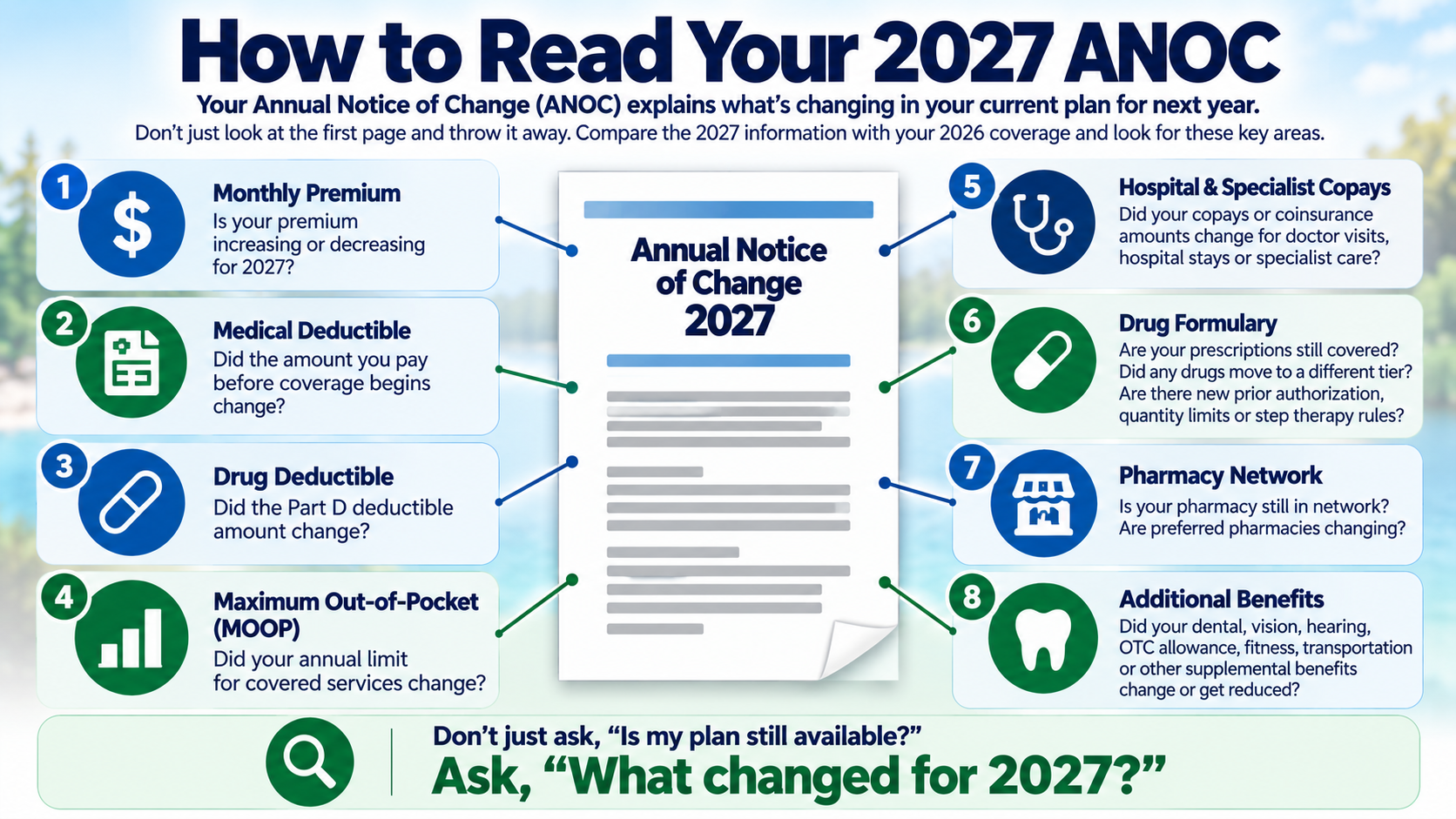
A plan that worked extremely well for you in 2026 could still be your best choice for 2027.
The purpose of reviewing your ANOC isn't necessarily to change plans.
It's to make an informed decision to stay rather than automatically renewing.
Two Ways to Build Your Medicare Coverage
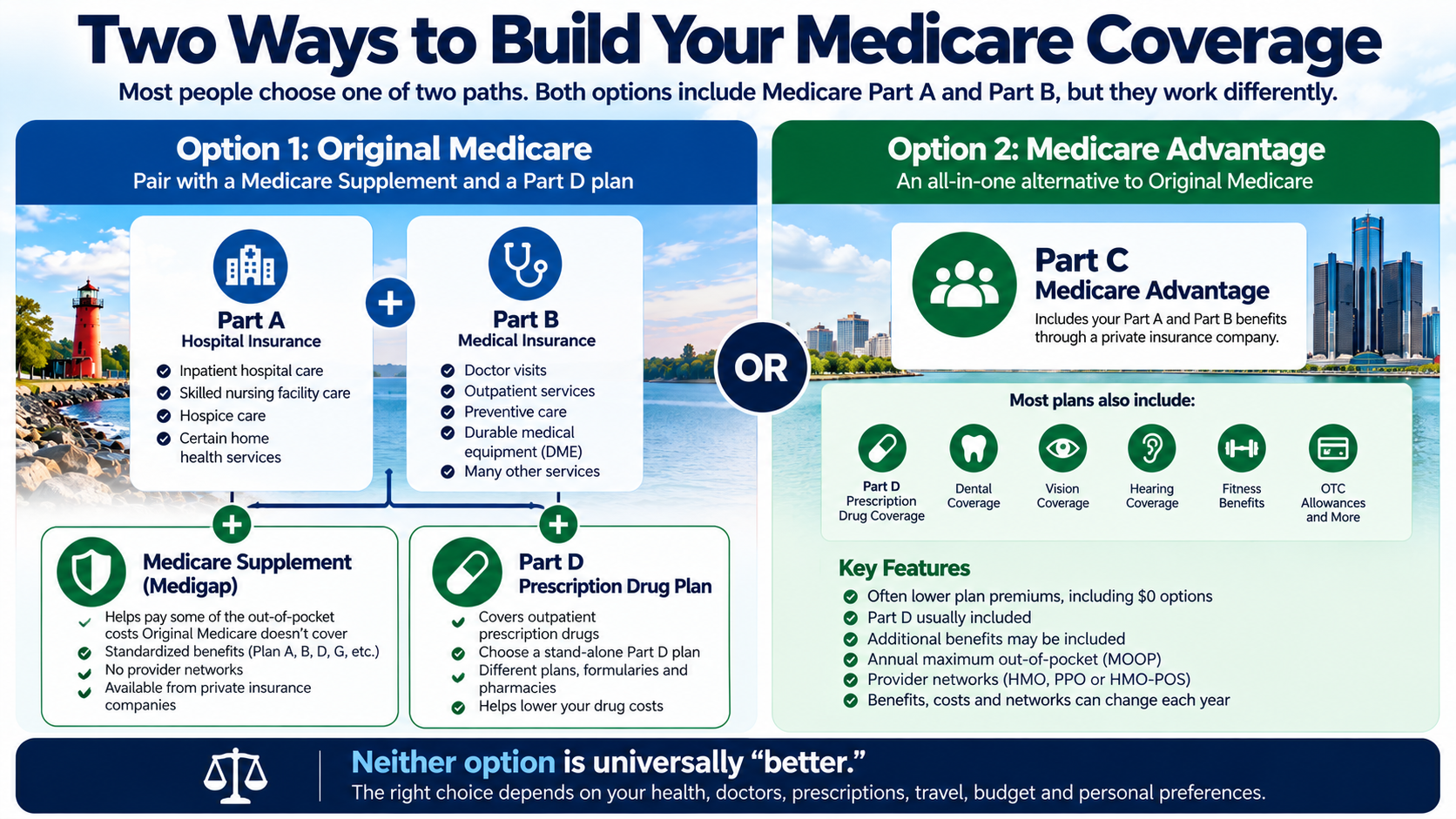
Most Medicare decisions ultimately lead down one of two general paths.
Path 1: Original Medicare
Part A generally covers inpatient hospital care, skilled nursing facility care, hospice and certain home healthcare services.
Part B generally covers physician services, outpatient services, durable medical equipment, preventive care and many other medically necessary services.
Original Medicare generally allows you to see doctors and hospitals throughout the United States that accept Medicare, without the provider-network structure typically associated with Medicare Advantage.
However, Original Medicare doesn't cover all healthcare expenses and doesn't include routine outpatient prescription drug coverage.
Many beneficiaries therefore pair it with:
Original Medicare + Medicare Supplement + Part D
Path 2: Medicare Advantage
Medicare Advantage, also called Part C, is an alternative way of receiving your Medicare Part A and Part B benefits through a Medicare-approved private insurance company.
Most Michigan Medicare Advantage plans also include Part D prescription drug coverage.
Plans may additionally offer benefits such as dental, vision, hearing, OTC allowances and fitness programs.
Unlike Original Medicare, Medicare Advantage plans generally use provider networks and plan-specific cost sharing.
You normally continue paying your Medicare Part B premium in addition to any Medicare Advantage plan premium.
Where Does Part D Fit?
Part D provides outpatient prescription drug coverage.
You can receive Part D through a stand-alone Prescription Drug Plan, or PDP, alongside Original Medicare, or through a Medicare Advantage plan that includes prescription coverage, commonly called an MA-PD.
Michigan has 11 stand-alone PDPs for 2027. Centers for Medicare & Medicaid Services
How to Compare Medicare Advantage Plans
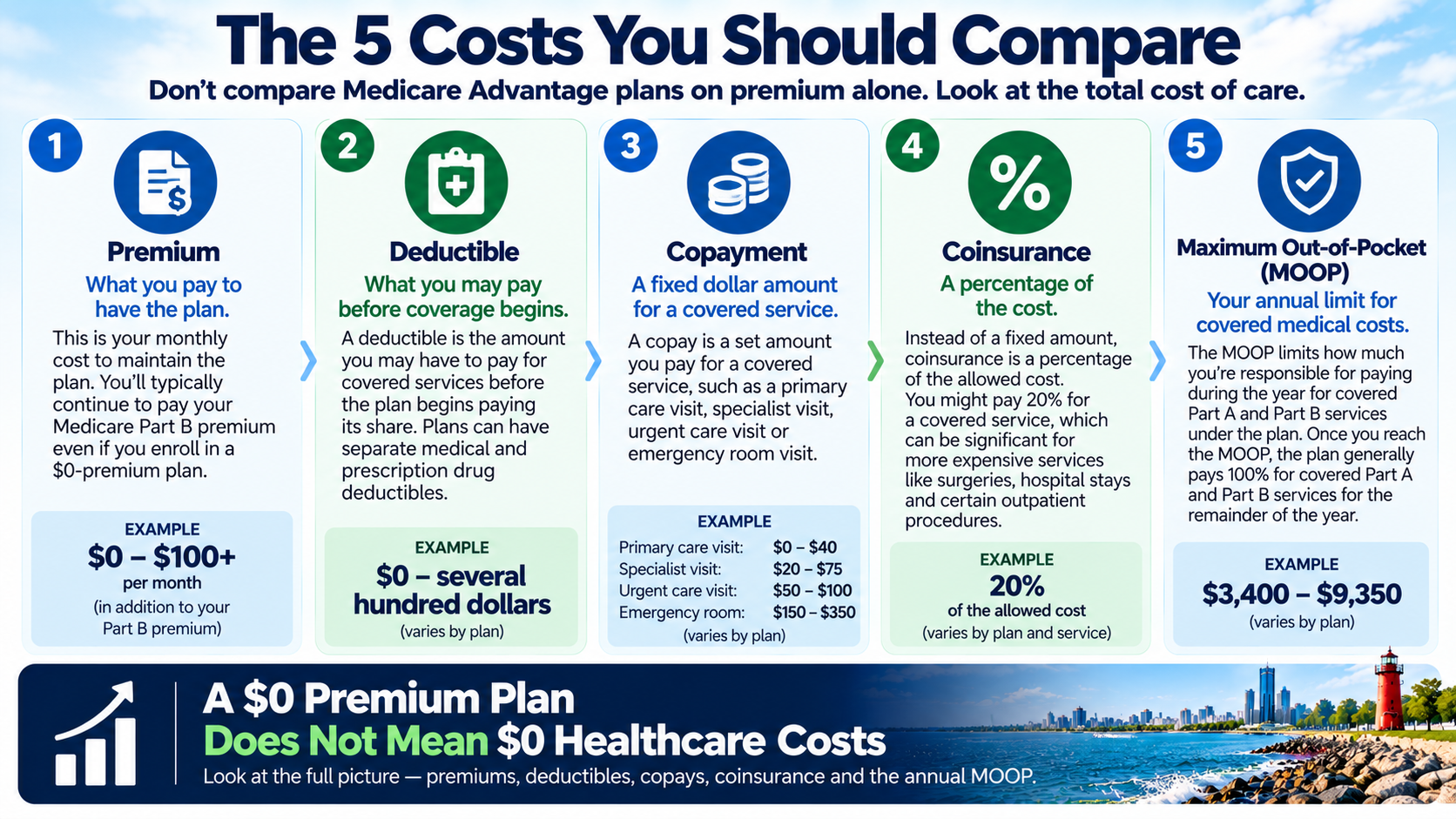
Premium gets a lot of attention, but it is only one number.
A $0-premium Medicare Advantage plan is not the same thing as $0 healthcare costs.
Premium
Your premium is what you pay to maintain the plan.
Remember that most Medicare beneficiaries must continue paying their Medicare Part B premium even if they enroll in a $0-premium Medicare Advantage plan.
Deductible
A deductible is an amount you may have to pay before the plan begins paying its share for certain services.
A plan can have separate medical and prescription drug deductibles.
Copayment
A copay is a fixed dollar amount.
For example, your plan might charge a set dollar amount for a specialist visit, emergency room visit or hospital stay.
Coinsurance
Coinsurance is a percentage rather than a fixed dollar amount.
If a service has 20% coinsurance, your cost depends on the allowed cost of that service.
This can become particularly important with expensive services such as chemotherapy, Part B drugs, durable medical equipment and certain outpatient procedures.
Maximum Out-of-Pocket — MOOP
The maximum out-of-pocket, or MOOP, limits how much you're responsible for paying during the year for covered Part A and Part B services under the applicable plan limit.
Once you reach the applicable MOOP, the plan generally pays 100% of covered Medicare Part A and Part B services for the remainder of the year.
Prescription drug spending generally does not count toward the Medicare Advantage medical MOOP because Part D has its own out-of-pocket structure.
Don't Compare Only the Best-Case Scenario
A useful question is not merely:
"What will this plan cost me if I stay healthy?"
Also ask:
"What could this plan cost me during a bad health year?"
Are Your Doctors and Hospitals in Network?
Don't check only your primary care physician.
Verify your:
Primary care physician
Specialists
Preferred hospital
Health system
Outpatient facilities
Therapy providers
Home health providers
Other providers you regularly use
And verify them specifically for 2027.
Don't assume that a provider participating in 2026 will remain in the network.
HMO vs. HMO-POS vs. PPO
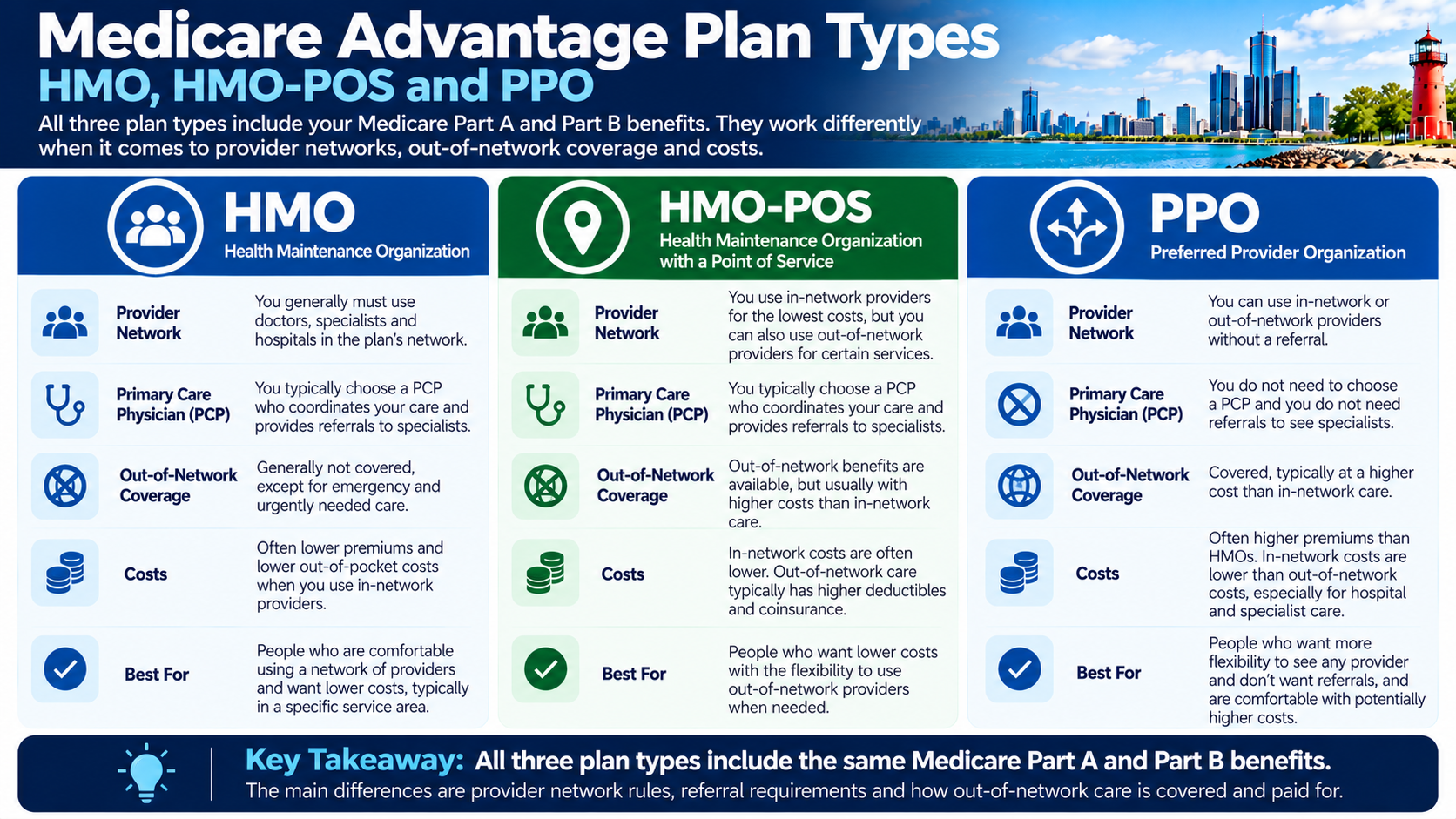
Generally, HMOs emphasize in-network care, PPOs tend to offer more out-of-network flexibility at potentially higher costs, and HMO-POS plans can offer certain out-of-network benefits depending on the plan.
Emergency and urgently needed care have special protections regardless of plan type.
Are You a Michigan Snowbird?
If you spend part of the year in Florida, Arizona, Texas or another state, don't assume every Medicare Advantage plan will work the same way away from Michigan.
Ask:
Can I receive routine care outside Michigan?
What happens if I need a specialist?
Does the plan offer out-of-network benefits?
Will doctors near my second home accept the plan?
Can I fill my prescriptions conveniently in both states?
A PPO may provide out-of-network benefits, but that doesn't necessarily mean every out-of-state provider will accept the plan or that your cost sharing will be the same.
Original Medicare plus a standardized Medicare Supplement can be attractive to frequent domestic travelers because Original Medicare generally allows beneficiaries to use providers nationwide that accept Medicare.
Travel patterns should be part of your Medicare decision, not an afterthought.
How Medicare Part D Works
1. Annual Deductible
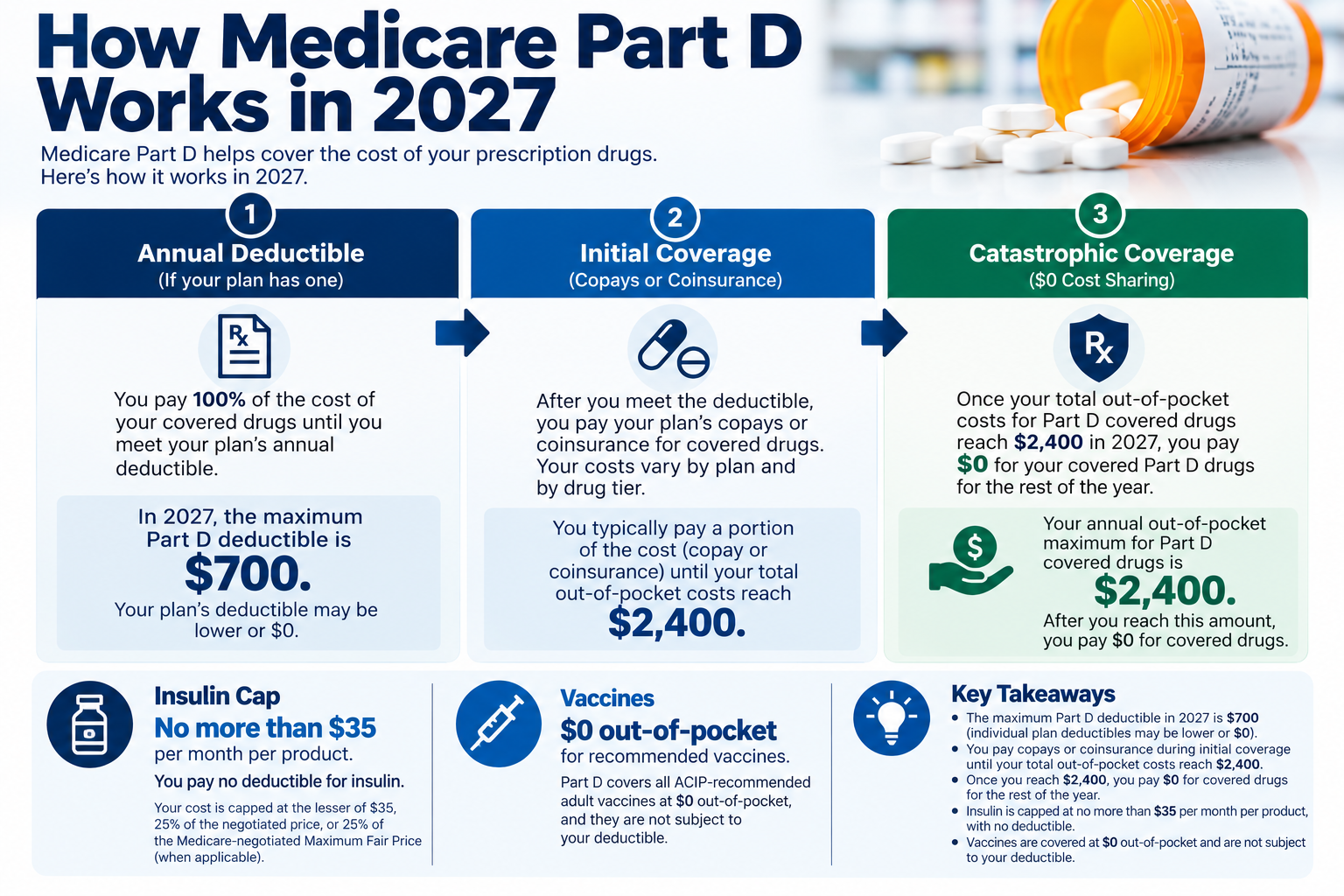
The maximum standard Part D deductible for 2027 is $700. Individual plans can have a lower deductible or no deductible. Centers for Medicare & Medicaid Services
2. Initial Coverage
After the applicable deductible, you pay your plan's copays or coinsurance for covered prescriptions.
Under the defined standard benefit, beneficiary cost sharing for most covered Part D drugs during this phase is 25%, although actual plan designs can use different copay and tier structures while meeting Medicare requirements. Centers for Medicare & Medicaid Services
3. Catastrophic Coverage
The 2027 annual Part D out-of-pocket threshold is $2,400.
Once your qualifying out-of-pocket spending reaches that threshold, you have $0 cost sharing for covered Part D drugs for the remainder of the year. Centers for Medicare & Medicaid Services
Insulin
Covered insulin is exempt from the Part D deductible. Beginning in 2026 and continuing in 2027, the applicable cost-sharing amount for a month's supply is the lesser of $35, 25% of the Medicare-negotiated Maximum Fair Price when applicable, or 25% of the plan's negotiated price. Centers for Medicare & Medicaid Services
Recommended Adult Vaccines
ACIP-recommended adult vaccines covered under Part D have $0 cost sharing and are not subject to the Part D deductible.
Don't Ask Only "Is My Drug Covered?"
Ask:
How is it covered?
Part D plans use formularies and tiers to determine coverage and cost sharing.
A medication may be covered by two plans but cost dramatically different amounts.
Plans may also use utilization-management requirements.
Prior Authorization
The plan may require your prescriber to provide information showing that a medication meets the plan's coverage criteria before it will pay for it.
Quantity Limits
A plan may limit the amount of a medication it will cover during a particular period.
Step Therapy
A plan may require you to try another covered medication before it covers a more expensive or different medication.
That's why a prescription comparison should include:
Drug name + dosage + quantity + frequency
rather than merely a list of medication names.
Pharmacies Matter Too
A prescription can have different costs depending on where you fill it.
Check whether your preferred pharmacy is:
In network
and
Preferred by the plan
Those aren't necessarily the same thing.
Also consider whether you're willing to use mail order.
For medications you take regularly, mail order or a preferred retail pharmacy may offer additional savings depending on the plan.
GLP-1 Coverage Is Especially Important in 2027
If you use a GLP-1 medication, don't assume its treatment under Medicare will be the same as another GLP-1 medication or another patient's prescription.
Your coverage can depend on the medication, FDA-approved indication, Medicare coverage rules and applicable program requirements.
The current article contains a detailed discussion of the temporary Medicare GLP-1 Bridge and its 2027 treatment. I would retain that section, but because this is a new and time-sensitive program, I would keep the supporting CMS references immediately adjacent to it and update the article if CMS changes its guidance.
If you use a GLP-1, verify exactly how your specific medication and medical indication will be handled before selecting a 2027 plan.
Don't Ignore Additional Benefits
Medicare Advantage plans may offer supplemental benefits such as:
Dental, vision, hearing, OTC benefits, fitness memberships, transportation and, for qualifying members and plans, certain food or grocery benefits.
These benefits can be valuable.
But don't let a benefit card determine your entire Medicare decision.
A generous dental allowance doesn't compensate for losing access to an important oncologist or facing significantly higher costs for a critical medication.
I recommend evaluating plans in this order:
1. Medical coverage and providers
2. Prescription coverage
3. Expected total costs
4. Additional benefits
Then determine how much value you'll realistically receive from the extras.
Should You Consider a Special Needs Plan?
Medicare Special Needs Plans, or SNPs, are Medicare Advantage plans designed for specific populations.
The three primary types are:
D-SNP: Designed for people eligible for both Medicare and Medicaid.
C-SNP: Designed for people with certain qualifying severe or disabling chronic conditions.
I-SNP: Designed for people living in, or meeting qualifying institutional levels of care.
C-SNP eligibility can include certain qualifying conditions such as diabetes, chronic heart failure, chronic kidney disease, ESRD and other qualifying chronic conditions.
Michigan's dual-eligible market is also changing for 2027, including the statewide expansion of MI Coordinated Health.
If you qualify for an SNP, compare it with your other available Medicare options rather than automatically assuming either choice is better.
Medicare Advantage vs. Medicare Supplement + Part D
This may be the most important decision in the entire guide.
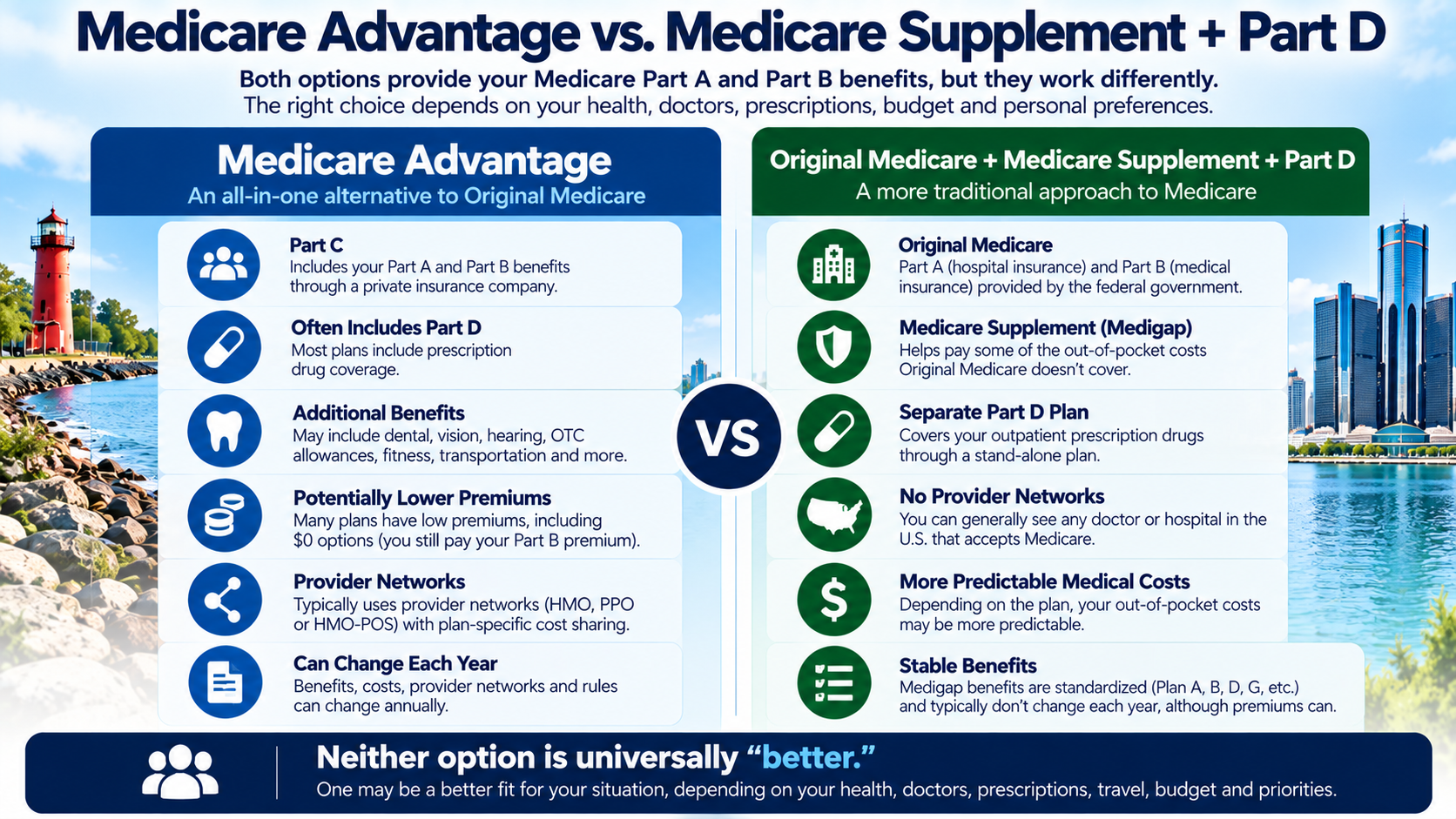
Neither approach is universally better.
They simply work differently.
Medicare Advantage
Medicare Advantage frequently offers:
Lower plan premiums, sometimes $0
Part D included in many plans
Dental, vision, hearing, OTC and other additional benefits
An annual medical MOOP
Coordinated plan benefits
In exchange, you may have:
Provider-network restrictions
Copays and coinsurance as you use healthcare
Plan-specific utilization rules
Benefits, costs and networks that can change annually
Original Medicare + Medicare Supplement + Part D
This combination typically involves:
Original Medicare Part A and Part B
A Medicare Supplement policy
A separate Part D prescription drug plan
The combined monthly premium is often higher, but medical expenses can be more predictable depending on the Medigap plan selected.
Medicare Supplement plans don't have provider networks in the same way as Medicare Advantage. Medical claims are processed through Original Medicare, so providers generally need to accept Medicare.
Medigap policies are standardized. In Michigan, a Plan G from one insurer provides the same standardized basic Plan G benefits as a Plan G from another insurer. Platinum Benefit Advisors, Inc.
But that doesn't mean every Medigap carrier is equal.
When comparing carriers, consider:
Premium
Financial strength
Length of time in the market
Customer service
Historical rate increases
Household discounts
Block experience
Also remember that after your Medigap Open Enrollment Period, you may have to qualify medically to purchase or change Medigap coverage unless you have a guaranteed-issue right or another applicable protection.
Standardized Medicare Supplement Benefits
| Medicare Supplement Benefit | A | B | C* | D | F* | G | K | L | M | N |
|---|---|---|---|---|---|---|---|---|---|---|
| Part A Hospital Coinsurance | 100% | 100% | 100% | 100% | 100% | 100% | 100% | 100% | 100% | 100% |
| Part B Coinsurance / Copayments | 100% | 100% | 100% | 100% | 100% | 100% | 50% | 75% | 100% | 100%** |
| First 3 Pints of Blood | 100% | 100% | 100% | 100% | 100% | 100% | 50% | 75% | 100% | 100% |
| Part A Hospice Coinsurance | 100% | 100% | 100% | 100% | 100% | 100% | 50% | 75% | 100% | 100% |
| Skilled Nursing Facility Coinsurance | — | — | 100% | 100% | 100% | 100% | 50% | 75% | 100% | 100% |
| Part A Deductible | — | 100% | 100% | 100% | 100% | 100% | 50% | 75% | 50% | 100% |
| Part B Deductible | — | — | 100% | — | 100% | — | — | — | — | — |
| Part B Excess Charges | — | — | — | — | 100% | 100% | — | — | — | — |
| Foreign Travel Emergency | — | — | 80% | 80% | 80% | 80% | — | — | 80% | 80% |
| 2026 Out-of-Pocket Limit | — | — | — | — | — | — | $8,000 | $4,000 | — | — |
* Plans C and F: Not available to people who became eligible for Medicare on or after January 1, 2020.
** Plan N: Covers Part B coinsurance, except for copayments of up to $20 for certain office visits and up to $50 for emergency room visits that don't result in inpatient admission.
High-Deductible Plans: Plans F and G also have high-deductible versions available in some states. The 2026 deductible is $2,950.
Note: Coverage percentages represent the portion of applicable Medicare cost-sharing covered by the supplement. Availability varies by state and insurance company. Massachusetts, Minnesota and Wisconsin standardize Medigap plans differently.
Original Medicare Costs for 2027
CMS has not yet released the final 2027 Part A and Part B beneficiary cost-sharing amounts as of October 4, 2026.
2027 Medicare Part A & Part B Costs: Update Pending
CMS has not yet announced the final 2027 Part B premium, Part B deductible, Part A hospital deductible and associated Original Medicare coinsurance amounts. Platinum Benefit Advisors will update this guide when CMS releases the official figures.
For context only, the 2026 standard Part B premium is $202.90 per month and the Part B deductible is $283. The 2026 Part A hospital deductible is $1,736 per benefit period. Centers for Medicare & Medicaid Services
Income Matters: IRMAA, Extra Help & Medicaid
Higher-income Medicare beneficiaries can pay an additional amount for Part B and Part D called an Income-Related Monthly Adjustment Amount, or IRMAA.
IRMAA generally uses your modified adjusted gross income from the tax return supplied to Social Security, typically from two years earlier.
2026 IRMAA Amounts
As of this article, CMS has not yet published the 2027 figures.
| Individual MAGI | Married Filing Jointly MAGI | Part B IRMAA | Total Part B Premium | Part D IRMAA |
|---|---|---|---|---|
| $109,000 or less | $218,000 or less | $0.00 | $202.90 | $0.00 |
| $109,001 – $137,000 | $218,001 – $274,000 | $81.20 | $284.10 | $14.50 |
| $137,001 – $171,000 | $274,001 – $342,000 | $202.90 | $405.80 | $37.50 |
| $171,001 – $205,000 | $342,001 – $410,000 | $324.60 | $527.50 | $60.40 |
| $205,001 – $499,999 | $410,001 – $749,999 | $446.30 | $649.20 | $83.30 |
| $500,000 or more | $750,000 or more | $487.00 | $689.90 | $91.00 |
MAGI: Modified Adjusted Gross Income.
Part B: The standard Medicare Part B premium is $202.90 per month in 2026. Higher-income beneficiaries pay the standard premium plus an Income-Related Monthly Adjustment Amount (IRMAA).
Part D: The Part D IRMAA amount shown above is paid in addition to the monthly premium charged by the beneficiary's Medicare prescription drug plan.
Important: Medicare generally determines IRMAA using income reported on your federal tax return from two years prior. Different income thresholds apply to certain beneficiaries who are married, lived with their spouse during the tax year, and file separate tax returns.
Source: Centers for Medicare & Medicaid Services (CMS) — 2026 Medicare Premiums and IRMAA
Extra Help
At the other end of the income spectrum, beneficiaries with limited income and resources may qualify for the Part D Low-Income Subsidy, commonly called Extra Help.
Extra Help can substantially reduce prescription drug costs.
Medicaid and Medicare Savings Programs
Beneficiaries with limited income and resources should also investigate whether they qualify for Medicaid or a Medicare Savings Program.
Don't assume you won't qualify without checking the applicable eligibility requirements.
Coordinate Medicare With Other Coverage
Don't make a Medicare decision in isolation if you have other insurance.
This is particularly important if you have:
VA benefits
TRICARE
Medicaid
Employer coverage
Retiree coverage
Union coverage
VA coverage, for example, can be extremely valuable, but VA benefits and Medicare operate as separate systems. Your Medicare decision can affect how you obtain non-VA care.
Likewise, don't cancel employer or retiree coverage until you understand what you're giving up and whether you could get that coverage back.
What Medicare Doesn't Cover
Even excellent Medicare coverage doesn't cover every potential expense.
One of the biggest gaps is long-term custodial care.
Medicare may cover qualifying skilled nursing and home healthcare under specific conditions, but it generally doesn't pay for ongoing custodial long-term care simply because someone needs assistance with activities of daily living.
That distinction can become financially significant.
Should You Add Ancillary Insurance?
Ancillary or umbrella insurance can sometimes address financial exposures that remain after selecting your core Medicare coverage.
Depending on your situation, options might include:
Hospital indemnity insurance can provide cash benefits associated with qualifying hospital stays and other covered services, which can help offset Medicare Advantage hospital copays.
Cancer insurance can provide cash benefits following a covered cancer diagnosis or treatment and may help with expenses beyond direct medical bills.
Critical illness insurance can provide cash benefits following covered conditions such as heart attack, stroke, or cancer, depending on the policy.
Home care and skilled nursing insurance may provide benefits for qualifying care needs that Medicare doesn't fully cover.
Stand-alone dental, vision, and hearing insurance can provide more comprehensive benefits when Medicare has limited coverage in those areas.
These products aren't replacements for Medicare. They're tools that may help address specific financial exposures.
What About a Spouse Who Isn't Medicare Eligible Yet?
Medicare is individual coverage, not family coverage.
When one spouse becomes Medicare-eligible and the other doesn't, the younger spouse needs a separate coverage strategy.
That might involve:
Employer coverage
COBRA
An ACA Marketplace plan
Other available individual coverage
This can affect the Medicare-eligible spouse's decision too.
For example, leaving employer coverage could affect the younger spouse's eligibility or cost.
Evaluate the household, not just the person turning 65.
Medicare Enrollment Periods for 2027
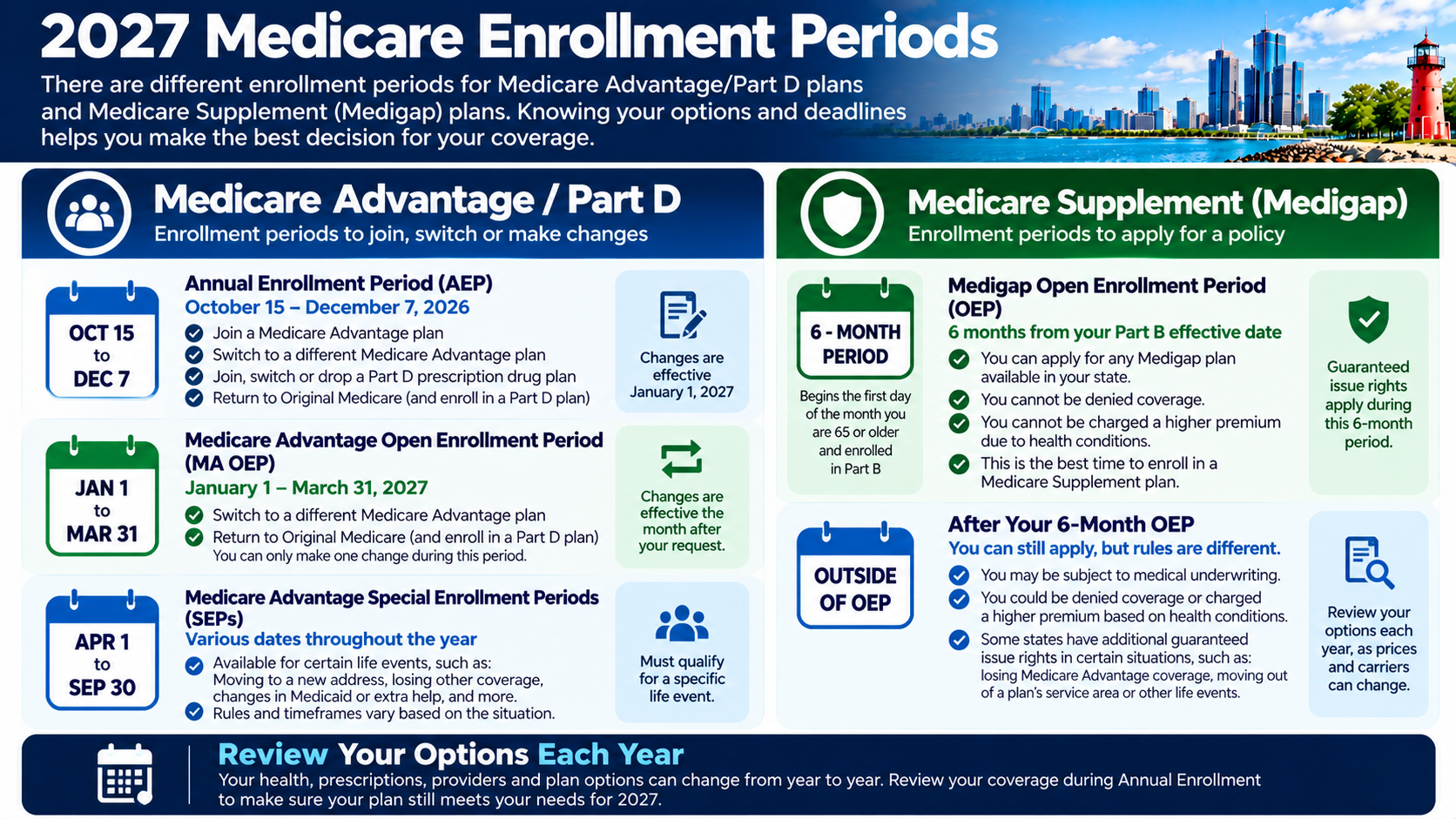
Annual Enrollment Period
The Medicare Annual Enrollment Period runs:
October 15 – December 7, 2026
with elections generally effective January 1, 2027.
During AEP, beneficiaries can make several changes involving Medicare Advantage and Part D.
Medicare Advantage Open Enrollment Period
The Medicare Advantage Open Enrollment Period runs:
January 1 – March 31
for people already enrolled in Medicare Advantage.
During this period, an MA member can generally make one change to another Medicare Advantage plan or return to Original Medicare and, where applicable, obtain Part D coverage.
Other Enrollment Periods
There are also Initial Enrollment Periods for people becoming Medicare eligible and numerous Special Enrollment Periods triggered by qualifying circumstances.
Not everyone is limited to AEP.
Understanding Medicare Advantage & Part D Star Ratings
I'd place Star Ratings here, rather than near the beginning.
CMS uses a 1-to-5-star system to help beneficiaries compare the quality and performance of Medicare Advantage and Part D plans.
Star Ratings can provide useful information about areas such as preventive care, chronic-condition management, member experience, customer service and prescription drug services.
But Star Ratings shouldn't be considered in isolation.
A highly rated plan still needs to work with your:
Doctors + hospitals + prescriptions + pharmacy + budget + healthcare needs.
Now Complete Your 2027 Medicare Annual Review
2027 Michigan Medicare Checklist
Prepare for Medicare Annual Enrollment. Review your coverage, compare your options, and make an informed decision.
1. Review Your Current Medicare Coverage
2. Doctors, Specialists & Hospitals
3. Prescription Drug Coverage
4. Compare Medicare Coverage Options
5. Compare Total Healthcare Costs
6. Additional Benefits
7. Other Coverage & Personal Considerations
8. Final Medicare Enrollment Decisions
Need Help With Your 2027 Medicare Coverage?
Platinum Benefit Advisors provides personalized Medicare guidance and plan comparisons.
Call or Text: 616-221-4616
Free Consultations | Office • Phone • Virtual
Contact an AdvisorShop 2027 Medicare Plans
Scan the QR code to explore your Medicare plan options.
This checklist is for educational purposes. Medicare plan availability, costs, provider networks, and benefits vary. Verify current information before enrolling.
Why Work With an Independent Medicare Agent?
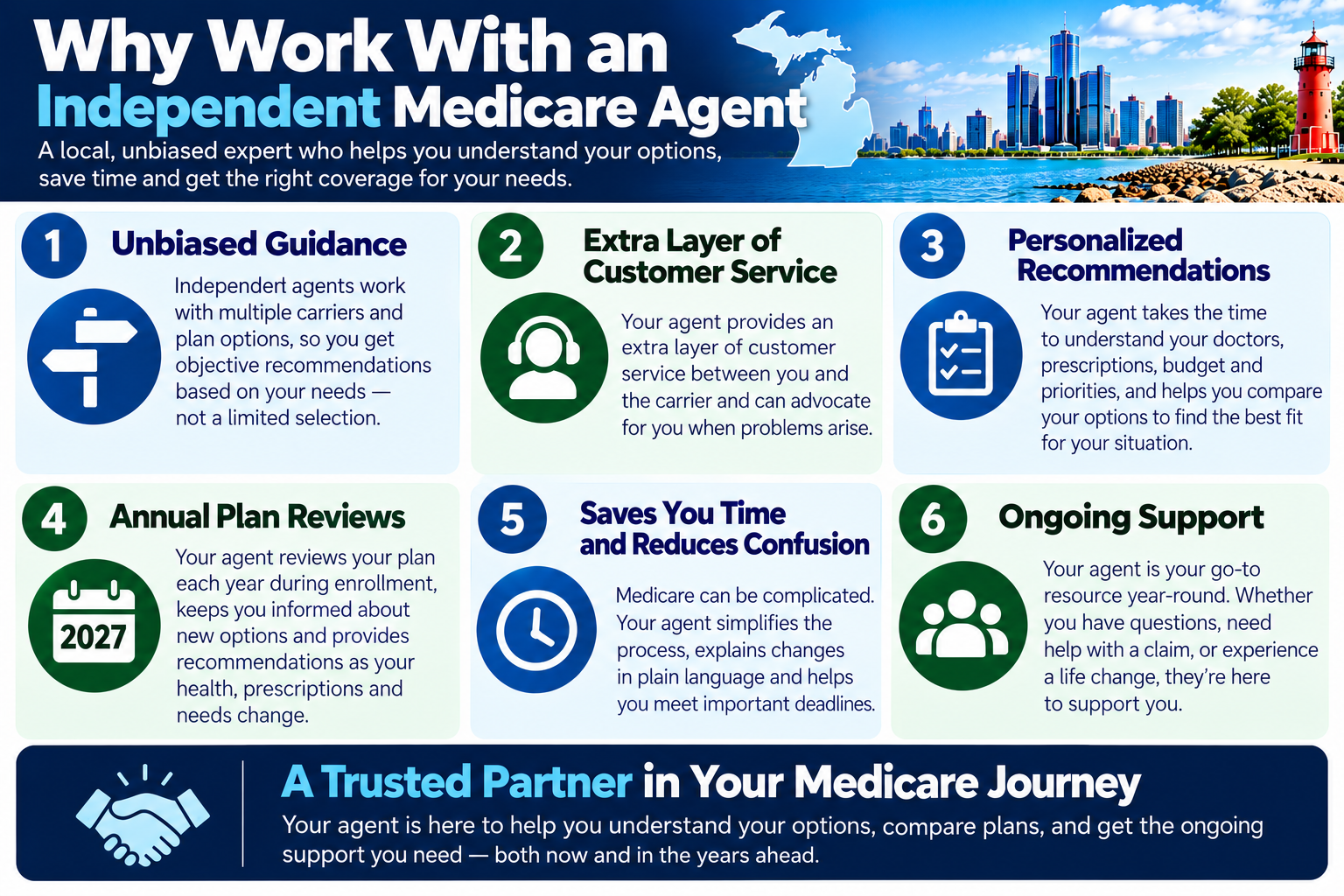
You can certainly research Medicare on your own, and Medicare.gov is an excellent resource.
But Medicare isn't simply a matter of finding the plan with the lowest premium.
An experienced independent Medicare agent can help you:
Compare plans from multiple insurance companies
Verify prescriptions
Review provider networks
Compare pharmacies
Explain deductibles, copays, coinsurance and MOOP
Compare Medicare Advantage with Medicare Supplement
Identify important differences between plans
Consider how those differences apply to your situation
Consumers generally don't pay an additional agent fee to enroll in Medicare Advantage, Part D or Medicare Supplement coverage through an agent. Agents are typically compensated by the insurance company when compensation is permitted for the product.
Your plan premium isn't increased simply because you used an agent.
At Platinum Benefit Advisors, the goal isn't simply to help you enroll in a Medicare plan.
It's to help you understand your options and make a decision based on your doctors, prescriptions, hospitals, pharmacies, healthcare needs, travel, budget and priorities.
The Bottom Line
There is no single "best Medicare plan in Michigan."
There may be a Medicare strategy that is better suited to you.
For one person, that might be a $0-premium Medicare Advantage HMO.
For another, it might be a PPO offering more out-of-network flexibility.
Someone eligible for Medicaid or living with a qualifying chronic condition may benefit from a Special Needs Plan.
A frequent traveler may prefer Original Medicare with a Medicare Supplement and Part D.
The right answer depends on the individual.
And in a year when more than 136,000 Michigan Medicare Advantage members are enrolled in plans leaving their county, reviewing your coverage isn't just paperwork. It can be an important healthcare and financial decision.
Need Help Choosing Your 2027 Medicare Coverage?
Talk with a licensed Medicare advisor at Platinum Benefit Advisors.
Your consultation is free.
Call or Text
616-221-4616
Meet on Your Terms
Office • Phone • Virtual
Important Medicare Disclaimer
We do not offer every plan available in your area. Any information we provide is limited to those plans we do offer in your area. Please contact Medicare.gov or 1-800-MEDICARE to get information on all of your options.

Get Help Choosing Your 2027 Medicare Coverage
Have questions about your Medicare options? Schedule a free consultation with a licensed Medicare advisor.
Call or Text 616-221-4616 Shop Medicare Plans →